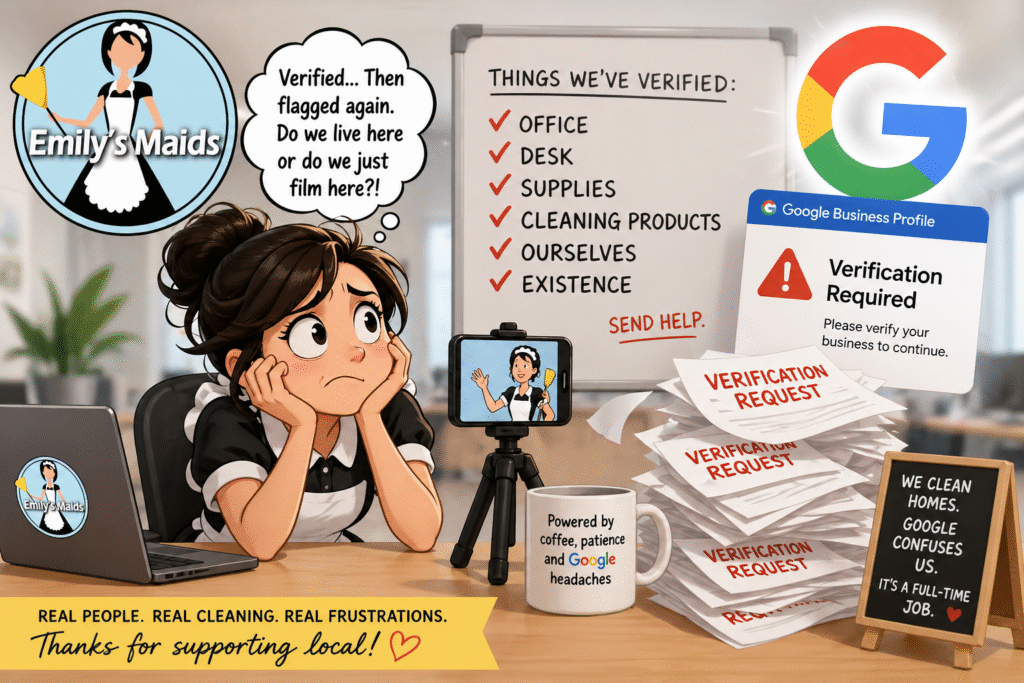
We’ve been having… let’s call them issues with Google lately. (it’s been longer than lately, but still) More specifically, with keeping our Google Business Profile alive and functioning without constant interruptions. And by interruptions, I mean a never-ending cycle of verify, re-verify, verify again, question your life choices, and then verify one more time just to be sure. It’s been a bit of a ride.
It all started pretty innocently. Years ago, another one of my businesses operated out of a condo, and it worked great. We had a washer and dryer for our cleaning rags, turned a bedroom and living room into office space, and used the dining room for supplies. It wasn’t glamorous, but it was efficient. Eventually, my first house cleaning service outgrew the space and moved into a proper office. So we figured, perfect, let’s move Emily’s Maids into the condo. Everything was fine for a while, until Google decided it wasn’t.
One day, out of nowhere, we got flagged and asked to verify the business. No problem. We filmed a video, showed the space, and got approved. Then we got flagged again. Another video. Approved again. Then we tried doing something wild, like updating our profile, and immediately got flagged again. Another video, another approval. Then we posted an update… flagged. At this point, it felt less like running a cleaning company and more like running a content studio dedicated exclusively to Google verification videos.
It was crazy… any action triggered a new verification request. Update your hours? Verify. Post something? Verify. Think about making a change? Probably verify. That’s when we decided to step things up and get a proper office off Highway 75. A real, legitimate business location. Surely this would solve the problem. We tried video verification again and got nowhere, so we escalated to a live walkthrough with a Google representative. We showed everything, answered all the questions, and finally got verified. It felt like a big win… until it wasn’t.
The moment we made a small update to the profile, boom, another verification request. At that point, the enthusiasm for filming yet another video was gone. It was less “professional business verification” and more “Hi Google, it’s us again, yes we’re still real, yes we still clean houses, please let us live.”
That’s when the realization hit. If we want stability on Google, we likely need something even more official (and expensive)… exterior signage, a visible storefront, the kind of setup that costs more than we actually need just to satisfy a system. Not ideal, but it is what it is.
Thankfully, we’ve had success with Google Ads, which has been bringing in business. And that leads to a slightly uncomfortable question: is this all intentional? For years, we’ve relied on leads from Dallas Maids, organic SEO, and customer referrals, all incredibly effective and, importantly, free. That’s how we built the business. Sure, we experimented here and there with Yelp or local sponsorships, but nothing major. Now, for the first time, we’re putting real money into marketing through Google Ads. And as organic visibility keeps shrinking, you start to notice a pattern.
It used to be that organic search results dominated, and people trusted them. Then came the Google Business Profile 3-pack, which became prime real estate. Then came Local Services Ads, sitting above even that, and those aren’t cheap. Now it feels like paid placement is slowly taking over more and more of the space, while organic opportunities get pushed further down. Coincidence? I don’t think so… Convenient for Google? Definitely!
Look, we understand that Google is a business, and businesses exist to make money. But it does make things harder for smaller, local companies trying to grow the right way. Because small businesses tend to operate differently. During COVID, for example, we received PPP funds. We used what we needed and gave the rest back to our employees as bonuses. Twice. Because that’s what felt right. It’s hard to imagine large corporations doing the same at that scale.
And that’s where a bigger thought comes in.
In parts of Europe, there are stronger protections for small businesses and local economies. The idea is simple: when local businesses do well, communities do well. Governments put guardrails in place to prevent large corporations from completely squeezing out smaller players. It’s not about stopping business, it’s about balance.
You see it in everyday life there. More independent shops. More local ownership. A stronger connection between businesses and the communities they serve. It creates an environment where small businesses aren’t just surviving, they’re part of the fabric of daily life.
Here, things tend to lean more toward scale and efficiency, which often favors large corporations. And while that brings certain benefits, it can also make it harder for smaller, service-driven businesses to compete, especially when platforms they rely on become increasingly pay-to-play.
That’s why small, local businesses matter. They take care of their teams. They care about their customers. They give back to their communities… and that’s not a marketing line. That’s reality. That’s why small, local businesses matter. They take care of their teams, they care about their customers, and they give back to their communities. When the system makes it harder for those businesses to thrive, it’s worth paying attention.
As for us, we’re still here. Still cleaning homes, still showing up, and still doing what we’ve always done: taking care of our customers and our team the right way. Trends change, systems evolve, and things don’t always make sense, but at the end of the day, the work stays the same. We show up, we do a great job, and we keep moving forward.